
Three Pillars: Efficacy and Mode of Action (MOA)
If You Only Have A and Z, You're Missing the Rest of the Alphabet.
Many of the biological companies I work with can tell you only two things about their product.
What it is and What production benefit does it yield.
That's A and Z.
And if that's all you have, you don't have a science story. You have a starting point and a finish line with nothing in between. No journey. No explanation. No reason for a grower, a dealer, or a distributor to trust that the yield response they're seeing is real, repeatable, and worth paying for.
The alphabet in between is your mode of action story. And most companies aren't building it.
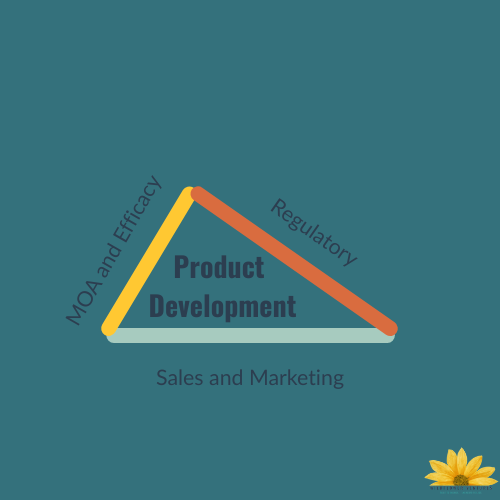
The Stool With One Short Leg
When the MOA and efficacy leg is short, the product still moves. You have yield data. You have something to show. But the story limps. Sales teams struggle to explain it. Growers can't visualize it. And the moment someone asks why it works, the conversation gets quiet.
If you've read The Three Pillars Every Ag-Bio Product Needs to Succeed, you know the framework.
Now picture the stool.
When the MOA and efficacy leg is short, the product still moves. You have yield data. You have something to show. But the story limps. Sales teams struggle to explain it. Growers can't visualize it. And the moment someone asks why it works, the conversation gets quiet.
That quiet is costing you more than you think.
Why Efficacy and Mode of Action Belong Together
These two are not separate workstreams. They are the same conversation.
Efficacy is your production metric. For row crops it's yield , bushels, pounds per acre, and for specialty crops it’s total yield plus quality metrics. Tomato growers get paid on coloration. Sugar beet growers care about brix and sugar content. The definition of efficacy changes by crop and by grower, but it always comes back to the same question: what does this do for my bottom line?
Mode of action is the explanation for why you're seeing that response.
A stress mechanism through a metabolic pathway?
An ion channel improving nitrogen uptake?
A nitrogen fixer producing more available nitrogen throughout the season?
Or a plant growth promotor that affects root elongation?
It doesn't have to be all the modes of action, but it does have to be a mode of action. Something that connects the mechanism to the outcome. Something that walks the grower from A to Z.
The reason these belong together is simple. You are already paying for the trial. Adding MOA assays or measurements alongside your efficacy work is incremental cost for exponential value in your storytelling. These can be such things as:
Soil tests throughout the season.
Greenness measurements at key growth stages.
A greenhouse trial focused entirely on the proposed mechanism.
These are not separate projects. They are additions to work you are already doing. And if you are running efficacy trials without building toward a mode of action story, you are leaving the most valuable part of your science on the table.
The Visibility Problem
Here is what makes this pillar uniquely hard for biological products.
Most of them work invisibly.
A grower applies your product and waits. If it's working the way it should, nothing dramatic happens. The plant just quietly performs better. There's no visible change. No moment of proof. Just a yield number at the end of the season that could have been influenced by a hundred other variables.
That is a very hard thing to sell.
Which means you have to create the visuals intentionally. You have to design for visibility from the beginning because once the trial is over, you cannot go back.
What does that look like in practice?
It could be a plate image showing your microbe in culture.
A recorded microscopy image of motile organisms moving toward a root.
A percolation test for a bio-based surfactant that shows water moving through soil differently.
Soil test data taken at three points throughout the season showing a measurable change.
Or greenness measurements mapped against a control at V6 and V10.
None of these are complicated, but all of them give a grower, a dealer, or an investor something to associate your technology with. Something they can see before they ever look at a yield number.
The companies that figure this out don't just have better marketing. They have better conversations. And better conversations close more deals.
Designing for the Story, Not Just the Data
This is the mindset shift that changes everything, and something RARELY taught in postgraduate programs.
Most companies run a trial and then go looking for something to say about it. They mine the data for usable moments after the fact.
That is backwards.
You should know what you want to say before you design the trial. What is the story you want to tell in three years? What does your grower need to see to believe it? What does a multinational's innovation team need to evaluate your technology?
I don’t mean that you fudge the assay and the data to make sure your product always performs. Scientific integrity is a non-negotiable. But you need to understand the other types of metrics to collect and all the various controls to add into the testing for maximum story telling ability.
The grower needs to walk from A to Z with you.
Build the alphabet.
Where to Start
Look at your current trial program and ask one question: if someone asked me tomorrow to explain why my product works, what would I show them?
If the answer is a bar graph of yield data, you have A and Z.
Start designing for the letters in between. Pick one MOA metric you can add to your next trial without significantly changing the cost or the protocol. One measurement. One image. One data point that starts to explain the mechanism.
That is how the story gets built. One letter at a time.
Not sure how strong your MOA and efficacy leg is? That is exactly what the Three Pillar Audit is designed to find out. Let's talk.
