
Three Pillars: Sales and Marketing Translation
Your Scientists Are Generating Stories Every Day, But Nobody Is Capturing Them.
Of the three pillars, sales and marketing through the science lens is most often the shortest leg.
This isn’t because companies don't care about sales and marketing. It’s because the people generating the most valuable raw material for sales and marketing (the scientists) were never trained to think that way. And nobody told them they needed to start.
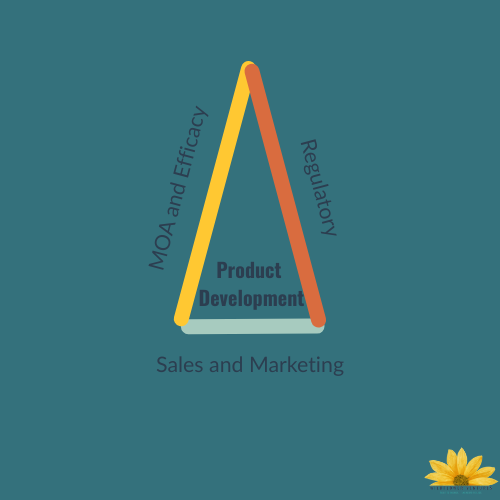
The Stool With One Short Leg
The science exists. The story doesn't.
If you've read The Three Pillars Every Ag-Bio Product Needs to Succeed, you know the framework.
Picture the stool again.
When the sales and marketing translation leg is short, the product has science behind it. It might even have a regulatory strategy and a solid efficacy story. But none of it is packaged in a way that a dealer can use in a sales call, a distributor can put in front of a retail buyer, or a grower can actually see and understand.
The science exists. The story doesn't.
And this is the leg I find short most often. Not because it is the hardest to build. Because it is the easiest to ignore until it is too late.
This Is Not About Yield
When I talk about sales and marketing through a science lens, I am not talking about yield data.
Yield is already covered in your efficacy pillar. What I am talking about here is applied science. The kind of science that shows your product working in the real world under real conditions.
Does it perform at low pH?
Does it survive in a dry formulation?
Does it stay viable in liquid?
Can it handle tank mixing?
Does it perform in the soil, on the seed, as a foliar?
These are the questions a dealer is going to ask before they put your product in their portfolio. These are the questions a distributor needs answered before they can confidently represent you. And these are the questions your sales team is going to face in the field that have nothing to do with a bar graph.
If your science program isn't generating answers to these questions, your sales team is going to improvise. And improvised answers to technical questions are how you lose credibility fast.
Making the Invisible Visible
Most biological products work invisibly. We talked about this in the MOA and Efficacy pillar. The plant just quietly performs better. Nothing dramatic happens. No visual moment of proof.
Which is exactly why the sales and marketing pillar has to do the work of making the invisible visible.
What does that actually look like?
If your mode of action is nitrogen fixation, how do you show nitrogen fixation through a science demo? Not a yield number. A demo. Something someone can see happening.
If your technology reduces methane, how do you show that at the lab level in a way a strategic partner can understand in thirty seconds?
If your product improves water absorption in the soil, what does a percolation test look like with your product and without it?
These are not marketing gimmicks. These are science demonstrations designed for a commercial audience. There is a difference between those two things, and it matters. The credibility comes from the science. The accessibility comes from how it is presented.
A plate image. A microscopy video of motile organisms moving toward a root. A side-by-side soil column showing infiltration rates. A time-lapse of germination with and without your seed treatment.
None of these require a separate budget line. They require someone to decide they are worth capturing.
The Real Problem: Nobody Is in the Lab Looking for the Story
Scientists are not trained to think about their customer. Especially scientists coming right out of academic programs. A fresh PhD is trained to think about rigor, replication, and publication. They are not thinking about what a grower in central Iowa needs to see to believe a product works. That is not a criticism. That is just what academic training produces.
So what happens?
A scientist develops a beautiful new assay. And then they run it with their experimental strains and their controls and they write up their results and move on.
Nobody took a picture. Nobody thought to add a current market product as a positive control. Nobody asked whether this assay could also generate new content for the product already sitting on the shelf.
That last one is worth sitting with for a moment.
Every assay your science team is running right now is an opportunity to also support the product you already have on the market. Throw in your current product as a control. Take a picture. Capture the result. You have just generated new sales and marketing material for an existing product at almost zero additional cost, while also running the experiment you needed to run anyway.
This is the mindset shift. And it does not happen on its own.
The Internal Reporter Problem
Someone needs to be in the lab asking different questions.
Not about statistical significance.
Not about pathway mechanisms.
Not how to troubleshoot an academic assay that isn’t working.
They need to be asking what can I do to support current and future sales.
Is this something a grower could understand if I showed them a picture?
Could we add one control here that makes this result more commercially useful?
What would a dealer think if they saw this assay running?
That is not a scientist question. That is a reporter question. And in most lean biological companies, nobody is asking it.
The result is a science program that generates years of valuable material that never makes it into a sell sheet, a pitch deck, a product page, or a social post. Not because the material wasn't there. Because nobody was looking for it.
Invite sales and marketing into the lab early. Not to run the science but to find the story. Let them ask the questions that scientists don't think to ask. Let them identify the moments worth capturing before the trial is over and the opportunity is gone.
Because once the trial ends, you cannot go back.
Where to Start
Walk through your current science program and ask three questions.
What are we generating right now that a non-scientist could understand if we showed them a picture or a short video?
What controls could we add to existing experiments that would create usable content for products already on the market?
Who is responsible for finding the commercial story inside our science? If the answer is nobody, that is your shortest leg.
This pillar does not require a massive investment. It requires a change in how scientists think about their work and someone whose job it is to bridge that gap.
One picture. One video. One additional control in an experiment you were already running.
That is where the story starts.
Not sure how much sales and marketing material your science is actually generating? That is exactly what the Three Pillar Audit is designed to find out. Let's talk.
