
Ag Biologicals Need a Rebrand
TL;DR
Ag Biologicals have a positioning problem. For decades, the industry has tried to sell biological products using a chemistry playbook focused on consistency, yield, and broad application. But biology doesn’t work that way. Biologicals are contextual, system-based tools that must be integrated, not stacked. To increase adoption, companies need to shift from yield-first messaging to problem-first positioning, clearly explain how their products work, and rethink how they train sales teams. The future of biologicals isn’t about better products; it’s about a better playbook.
Agricultural Biologicals Have a Branding Problem
For the past 10+ years, we’ve been developing and selling biology-based products in the same way we sell chemistry-based products. I’ve said this before and I’ll keep saying it.
We cannot bring a biological to market like it’s a nitrogen fertilizer.
Nitrogen works everywhere, on everything. Biologicals are just not that.
And yet, here we are. Still trying to force them into that same framework.
I’m so tired of hearing that ag biologicals are inconsistent—or worse, snake oil. They are not inconsistent. They just don’t work in all places on everything. That’s not a science problem. That’s a perception problem. And perception is driven by how we position and talk about these products.
How Did We Get Here?
Around the turn of the century, agriculture went through a massive transformation. Specialization, mechanization, and the rise of chemistry-based fertilizers fundamentally changed how we farm. We built systems that could be deployed across geographies and cropping systems with a high degree of consistency. It was efficient. It scaled. And it worked.
And to be clear, it worked really well. We’ve made incredible progress in food production. We can feed a growing population with less land than ever before.
But we’ve also hit a ceiling. We’re no longer seeing those massive jumps in yield. I believe we are living in an era of incremental gains and diminishing returns. And that changes the game.
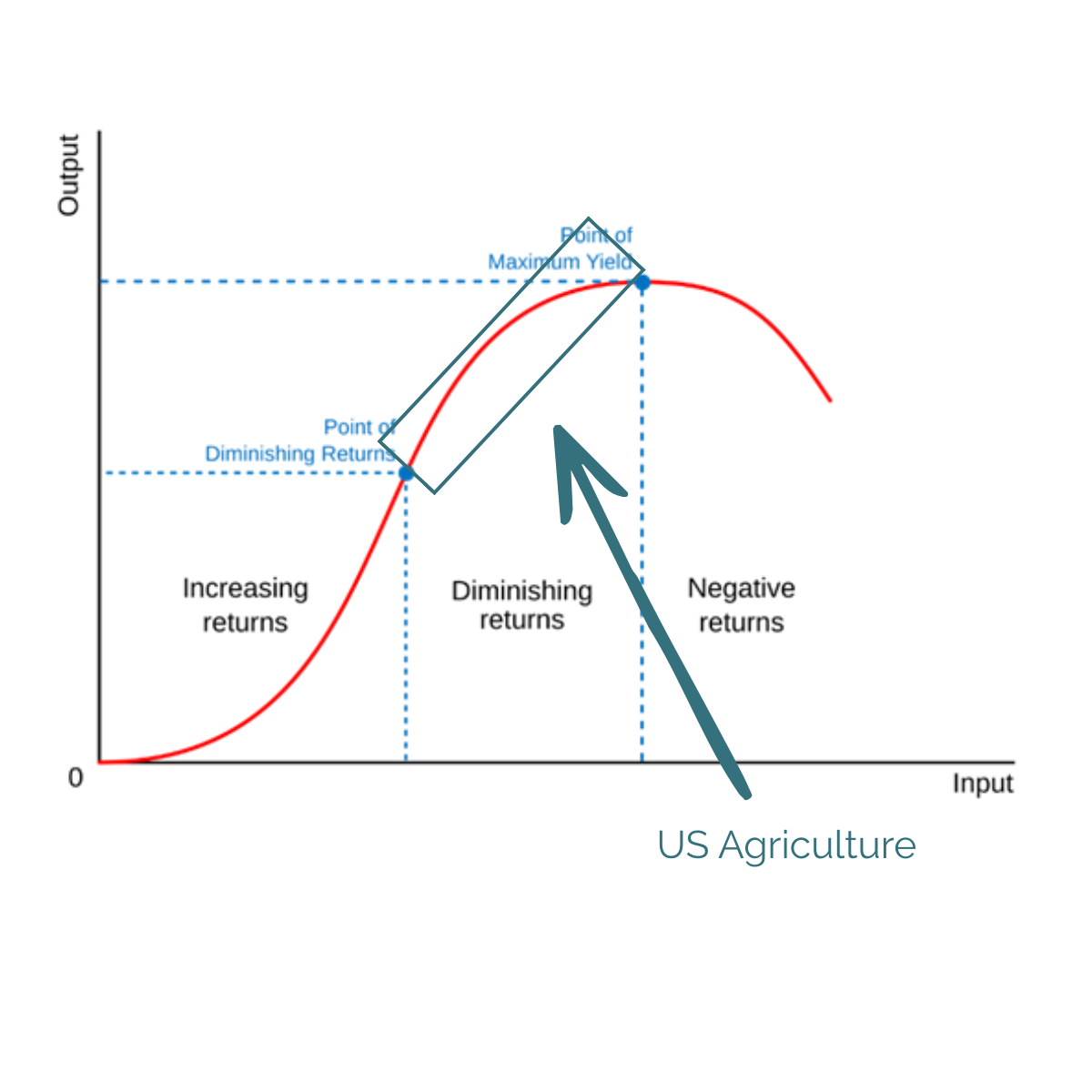
Now, the question isn’t “what can I add to get more yield?”
It’s “how do I protect what I already have?”
The old mindset was simple: add a product, increase yield, measure ROI. Stack enough products together and you keep climbing. But that’s not where we are anymore.
Now, the question isn’t “what can I add to get more yield?”
It’s “how do I protect what I already have?”
From Stacking to Optimization
We’ve been operating in a stacking mindset for decades. Add this product. Get X more bushels. Repeat.
But biological products don’t fit neatly into that model. And honestly, most other agricultural technologies won’t continue in this manner much longer.
We need to shift from stacking to optimization. This means instead of asking how to add yield, we should be asking how to stabilize and protect what we already have gained.
How do we reduce variability?
How do we help growers manage risk?
How do we support the system so that yield becomes the natural outcome?
That’s a fundamentally different way of thinking, and it requires us to reposition agricultural biologicals from the ground up.
Stacking vs. Integration: What does that mean?
Let me give you a practical example.
Right now, the pitch for a biological product often sounds like this: “If you use this product at planting, you’ll get an extra $10 per ton.”
That’s stacking. You’re asking a grower to layer something on top of what they’re already doing and hope it pays off.
What if we said this instead:
“This product helps prime the plant’s stress response, allowing it to better withstand late frost, dry conditions, and disease pressure. When applied at key stages, early vegetative growth, fruit set, and maturation, we’ve seen improvements in total yield and quality.”
That’s integration.

Biology is not something you stack. It’s something you integrate.
And until we start positioning biologicals that way, adoption will continue to lag.
The Real Misunderstanding
At the core of this issue is a misunderstanding of how biology works compared to chemistry. Chemistry tends to be linear. You apply a product, it targets a specific pathway, and you get a predictable outcome. Think of herbicides … one pathway, one result.
Biology doesn’t work like that. Biology operates within systems. It interacts with soil, weather, crop physiology, microbial communities, everything. It’s dynamic and demands context.
So when we try to force biological products into a linear, chemistry-based narrative, we lose the plot.
Remember, yield is not the problem to be solved. Yield is the OUTCOME of affecting one part of the whole system – from planting to harvest and everything in between.
The Current Brand of Ag Biologicals
And yet, here’s how most agricultural biologicals are still being sold: “Want more yield? Use Product X for +5 bushels.”
YUCK.
There is rarely any talk about where it fits into the system, when to use it, why would you want to use it, how/why it works. We don’t arm our salesforce with the knowledge they need to sell biological products.
They need to know how the product works, when to recommend it, and best use guideline on how to make biological products more consistent. Growers and distributors need to SEE the product in their own operation. What do they look like using the product and what does success look like?
We’ve muddied the waters for long enough. It’s time to start creating clarity.
The Rebrand
So what does it mean to rebrand ag biologicals?
It’s not just about better messaging or nicer marketing materials. It’s about changing the entire lens through which we approach these products.
We need to stop leading with productivity claims and start leading with real grower problems. Not theoretical yield loss. Actual, tangible challenges in the field.
And yes, I know … it’s not that simple.
We also have to think about the sales channel.
What problems are dealers and distributors facing?
Where are their gaps?
How do we create solutions that work at both the field level and the channel level?
This is where things get complicated. But it’s also opportunity exists.
We also need to abandon vague claims and start offering clear, visual explanations of what these products do and how they work. Growers need to see themselves using the product. They need to understand the type of operation it fits into.
And we need to stop with what I call the “not theirs” strategy, where companies spend all their time explaining how they’re better than competitors without ever explaining what their own product actually does.
That doesn’t build trust; it builds confusion.
Science Shouldn’t Be Hidden
There’s also this idea floating around that messaging needs to be simple, which somehow turned into “don’t talk about the science.”
That’s a mistake.
Science doesn’t have to be complicated; we’ve just made it that way. By hiding the mechanism of action, we’re actually hurting our credibility. “Trust me, it works” doesn’t actually work anymore. We, as a biological industry, have made too many broad claims that have fallen flat. Dive into the science. Make it accessible. It will help, I promise.
If we want to increase adoption of biological products in agriculture, we need to explain them. Make the science accessible. Bring people into the process.
The Internal Shift
Rebranding doesn’t just happen externally. It starts inside the organization.
Right now, we’re recycling sales talent across companies. Many of whom were trained in chemistry-based systems. They’ve been taught to sell consistency, broad application, and yield gains. But biologicals don’t fit that script.
You can’t sell biology with a chemistry mindset. We need to rethink how we hire, how we train, and how we support sales teams if we want agricultural biologicals to succeed.
If you want to hear more about the changes I propose, read this blog: Why Biological Products Struggle to Scale: The Science-to-Sales Translation Problem.
The Future Brand of Agricultural Biologicals
The future of agricultural biologicals isn’t about becoming the next commodity input.
It’s about differentiation.
It’s about solving very specific problems for very specific growers in very specific conditions. It’s about integrating into systems, not stacking on top of them.
It’s about moving from broad claims to precise applications. From simplified messaging to clear explanations. From selling yield to supporting outcomes.
The opportunity isn’t just better products. It’s a better approach to how we develop, position, and bring those products to market.
Final Thought
Agricultural biologicals don’t need better PR. They need a different playbook.
And that rebrand starts with how we think, how we talk, and how we show up in the market.
I’m leading the charge to rebrand ag biologicals.
Who’s with me?
-
Agricultural biologicals are not inherently inconsistent—they are context-dependent. Their performance varies based on soil, climate, crop, and management practices, which means they need to be applied more intentionally than chemistry-based inputs.
-
Adoption is often slowed by unclear positioning, overly broad claims, and a lack of clarity around how biological products fit into real farming systems.
-
Biologicals should be integrated into the system—timed and applied based on specific conditions—rather than stacked as an add-on for yield.
-
Most companies position biologicals around yield, but that approach often misses the mark. Biological products should be positioned around specific problems within a system—clearly defining where, when, and why they should be used.
-
In many cases, it’s not a performance issue. It’s a clarity issue. If the product is positioned too broadly or lacks a clear use case, growers and distributors struggle to understand where it fits.
-
Treating them like chemistry-based products. Using broad claims, focusing only on yield, and trying to scale too quickly without establishing clear, specific use cases.
-
Adoption improves when confidence improves. That comes from clearly explaining how the product works, where it fits in the system, and giving sales teams the tools to communicate that effectively.
-
They need more than performance data. Sales teams should understand how the product works, when it should be used, and how to explain it in a way that makes sense within a grower’s operation.
-
From the beginning. Product development, regulatory, and sales strategy should be aligned early so the product is designed with real-world use and communication in mind.
-
Differentiation comes from specificity. Clearly define your use case, explain how the product works, and be transparent about where it performs best.
-
If your team struggles to explain the product clearly or adoption is inconsistent, it’s often a sign that positioning, messaging, or system fit needs to be revisited.
